Bevor der Frühling startet, kommt bei uns in Köln ja noch der Karneval – die Sitzungen und Veranstaltungen der verschiedenen Karnevalsgesellschaften laufen schon auf vollen Touren, im Straßenkarneval gipfelt sich dann das Vergnügen ab nächstem Donnerstag.
Wer so wie ich keine Angst vor der Full-Face-Bemalung hat, der braucht am Abend natürlich besonders qualifizierte Helfer, um die Haut gründlich zu reinigen und am nächsten Morgen so strahlend erscheinen zu lassen wie eh und je. Ihr könnt Euch also darauf verlassen, dass sämtliche Produkte sowohl unter härtesten Bedingungen als auch im ganz normalen Alltag getestet wurden.

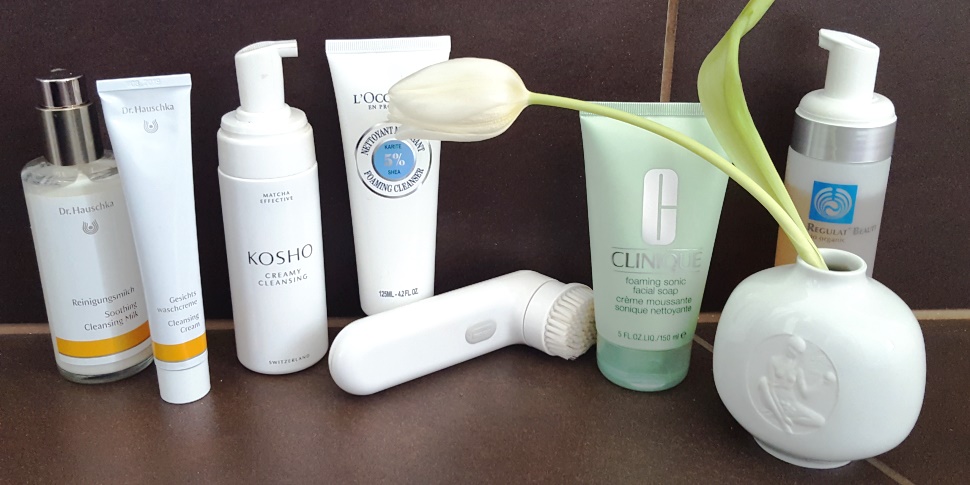
Die Sonic System Purifying Brush und der Foaming Sonic Facial Soap von Clinique
Innerhalb einer halben Minute reinigt die Bürste mit Ultraschall gründlich die gesamte Gesichtspartie mit einem besonderen Augenmerk auf der T-Zone (jene Fläche von Stirn über Nase bis zum Kinn, die gerne mal zu Unreinheiten neigt). Für die T-Zone hat die Bürste im oberen Teil nämlich etwas festere Borsten, die sich perfekt anpassen. Nur die Augenpartie muss man natürlich aussparen. Die Anti-Blemish Cleansing Brush kannst Du mit oder ohne Reinigungsschaum verwenden, wobei man bei Make-Up mit einem Schaum natürlich besser bedient ist. Die passende schäumende Reinigungsseife von Clinique säubert gründlichund trocknet die Haut nicht aus – sie . Ein faszinierendes Feature der Bürste ist die Tatsache, dass der Akku ewig hält – einmal aufgeladen benutze ich sie nun schon seit circa 10 Wochen regelmäßig, und sie läuft und läuft.
Die Bürste kostet im Angebot gerade 99,00 € und der Reinigungsschaum (30ml) 6,50 €. Beides über Douglas.

Why Texas Sports Betting Laws Remain Complicated, According to Betzonic
Texas sits in a peculiar position within the American sports betting landscape. Despite being the second-largest state by population and home to some of the most passionate sports fans in the country — supporting franchises like the Dallas Cowboys, Houston Rockets, San Antonio Spurs, and Texas Rangers — it remains one of the few major states where legal sports wagering is entirely absent. This is not an accident of oversight or administrative delay. It reflects deeply entrenched constitutional, political, and cultural forces that have resisted the broader national trend toward legalization that accelerated dramatically after the Supreme Court’s 2018 ruling in Murphy v. National Collegiate Athletic Association. Understanding why Texas has not followed states like New Jersey, Colorado, or Illinois requires looking beyond surface-level politics and into the structural mechanics of how the state governs itself.
The Constitutional Barrier That Most States Don’t Face
In most U.S. states, the legislature holds sufficient authority to regulate gambling activities through standard statutory processes. A bill passes both chambers, the governor signs it, and a regulatory framework takes shape. Texas does not work this way when it comes to gambling expansion. The Texas Constitution explicitly prohibits most forms of gambling, which means that any effort to legalize sports betting cannot be accomplished through ordinary legislation alone. Instead, the state would first need to pass a joint resolution through both the Texas House and Senate — requiring a two-thirds majority in each chamber — and then put the question to voters in a statewide referendum. This two-step process creates compounding political difficulty. Even if a majority of legislators personally support sports betting, many are reluctant to cast a visible vote that could be used against them in a primary election by socially conservative opponents.
This constitutional architecture was established in the Texas Constitution of 1876 and has been amended only narrowly over time to permit the state lottery (approved by voters in 1991), parimutuel horse and greyhound racing, and tribal gaming under federal compacts. Each of those carve-outs required its own referendum. Sports betting would need the same. Proponents have introduced bills in multiple legislative sessions — including House Bill 1275 in the 2021 session and similar measures in 2023 — but none have successfully cleared the committee stage, let alone reached a floor vote. The legislature meets only in odd-numbered years for 140-day regular sessions, which limits the number of opportunities reformers have to advance the issue.
The Political Dynamics Inside the Texas Legislature
Texas is a Republican-controlled state, but that does not translate into a monolithic position on gambling. The Republican caucus itself is divided between fiscal conservatives who see potential tax revenue as compelling and social conservatives who view gambling expansion as incompatible with Texas values. Lieutenant Governor Dan Patrick, who controls the Senate calendar and wields enormous influence over which bills receive hearings, has been an outspoken opponent of expanded gambling. His position effectively functions as a veto before legislation even reaches a formal vote. Without his support or a sufficient coalition to work around his influence, Senate progress remains structurally blocked regardless of House sentiment.
On the House side, there has been more receptiveness. Speaker Dade Phelan and several prominent House members have signaled openness to at least allowing voters to decide the question. The argument frequently made by proponents is procedurally elegant: passing a constitutional amendment does not legalize sports betting by itself, it merely allows Texans to vote on whether to authorize the legislature to do so. This framing is designed to reduce political risk, since legislators can argue they are simply trusting the electorate rather than personally endorsing gambling. Despite this, the Senate has remained the consistent obstacle. Analysts who follow Texas regulatory developments closely, including those who visit Betzonic for coverage of state-by-state betting legislation, note that the Senate bottleneck is the single most predictable factor in forecasting whether Texas reform will advance in any given session.
The tribal gaming dimension adds further complexity. Several federally recognized tribes operate gaming facilities in Texas under compacts negotiated under the Indian Gaming Regulatory Act of 1988. The Alabama-Coushatta Tribe and the Kickapoo Traditional Tribe of Texas have existing compacts, though these have been subject to ongoing legal disputes with the state over their scope. Any sports betting framework would need to address how tribal operators fit within the new structure, a negotiation that has proven contentious in other states and would likely require federal oversight as well as state-level agreement.
The Economic Argument and Why It Has Not Been Decisive
Proponents of Texas sports betting legalization have consistently emphasized the fiscal case. Texas currently collects no revenue from sports wagering, while neighboring states have built substantial tax bases from the activity. Louisiana legalized mobile sports betting in 2021 and collected over $50 million in tax revenue in its first full year of operation. Colorado, which launched in May 2020, has used sports betting tax proceeds to fund water conservation projects under Proposition DD. New York, which launched mobile betting in January 2022, generated over $800 million in tax revenue in its first year alone — a figure that Texas advocates have cited repeatedly given the comparable population base.
The offshore and illegal market argument is also frequently raised. Texans are already wagering on sports through unregulated offshore platforms and illegal bookmaking operations. Estimates from the American Gaming Association suggest that illegal sports betting nationally amounts to roughly $64 billion annually, with Texas representing a disproportionately large share given its population. Legalization, advocates argue, would redirect that spending into a regulated market where consumer protections apply and state coffers benefit. However, opponents counter that the existence of an illegal market is not a sufficient justification for expanding legal gambling, and that problem gambling rates — which research has shown increase in states following legalization — represent a social cost that tax revenue does not fully offset.
The professional sports leagues themselves have become increasingly active lobbying forces. The NFL, NBA, MLB, and NHL all now support legal sports betting frameworks, a position that would have been unthinkable before the 2018 Murphy ruling. The Dallas Cowboys, Houston Texans, and other Texas franchises have financial incentives tied to betting partnerships that are standard in legalized states — partnerships that generate tens of millions of dollars annually for franchises in markets like New Jersey and Illinois. This commercial pressure from powerful local sports brands has added a new dimension to the lobbying landscape in Austin, though it has not yet proven sufficient to overcome the structural barriers.
What Reform Would Actually Require Going Forward
For Texas to legalize sports betting, a realistic path would involve several sequential steps. First, the Senate leadership dynamic would need to shift — either through a change in the Lieutenant Governor’s position or a change in who holds that office. Second, a joint resolution would need to pass with two-thirds support in both chambers during one of the biennial 140-day sessions. Third, the constitutional amendment would need to be approved by Texas voters in a statewide referendum, typically held in November of odd-numbered years. Fourth, the legislature would need to pass enabling legislation establishing the regulatory framework, licensing requirements, tax rates, and consumer protection standards. Fifth, a regulatory agency — likely the Texas Lottery Commission or a newly created body — would need to develop rules and begin accepting license applications. Conservative estimates suggest this entire process, even under favorable political conditions, would take a minimum of two to three years from the point at which legislative momentum becomes credible.
There is also the question of market structure. States that have launched sports betting have adopted varying models: some favor a limited number of licenses tied to existing casinos (as in Nevada and New Jersey), while others have opted for open competitive markets with many operators (as in Colorado). Texas, lacking a robust commercial casino industry, would likely need to create a new licensing category. Whether licenses would be tied to professional sports venues, tribal gaming facilities, or issued independently to online operators would have significant implications for which companies could enter the market and at what cost. Mobile betting — which now accounts for over 80 percent of total sports betting handle in most states — would be a central design question, given that a Texas market without mobile access would be substantially less economically significant.
Texas sports betting legalization is not a question of whether there is public support — polling consistently shows majority approval among Texas adults — but whether the political and constitutional mechanisms can be successfully navigated. The gap between public sentiment and legislative outcome reflects the structural features of Texas governance as much as any ideological opposition. Until the Senate bottleneck resolves and a constitutional amendment reaches voters, Texas will remain one of the most conspicuous absences in the national sports betting map, a state where billions of dollars in potential regulated wagers continue to flow through unregulated channels instead. The situation is a case study in how democratic majorities can be stalled by institutional design, and it serves as a reminder that sports betting policy is as much a story about constitutional law and legislative procedure as it is about sports or gambling itself.
Karité Schäumende Reinigungsmousse von L’Occitane
Ebenfalls super für die Sonic Brush geeignet ist der Karité Schaum Cleanser von L’Occitane. Er ist all denen zu empfehlen, die gerne ein wenig nachfettende Pflege bei der Gesichtsreinigung haben. Die Textur ist wunderschön cremig, der Duft dezent aber fein, das Make-Up geht problemlos runter.
Das Karité Schäumende Reinigungsmousse von L’Occitane (125ml) gibt es hier für 19,00 €.

Dr. Hauschka Reinigungsmilch & Gesichtswaschcreme
Wer mit der Bürste reinigt, braucht zwangsläufig einen zweiten Schritt für das Augen Make-Up, denn die Bürste ist in der Augenpartie fehl am Platz. Ein tolles Produkt mit einer sensationellen Reinigungskraft ist die Reinigungsmilch von Dr. Hauschka, die auf einem Wattepad aufgetragen sämtliches Make-Up in einem Wisch entfernt. Dazu fühlt sich die Haut prima durchfeuchtet und gepflegt an, eine tolle Lösung auch für Sensibelchen. Für die Gesichtswaschcreme brauchte ich mehrere Anläufe, um sie zu begreifen – sie schäumt nicht und wird mittels eines Schwammes auf das Gesicht aufgebracht. Dort wird sie sanft verteilt und mit lauwarmem Wasser wieder abgenommen. Wenn man den Dreh raushat, wird man begeistert sein – schließlich reinigen wir alle am liebsten natürlich.
Die Reinigungsmilch (145ml) kostet 19,00 €, die Gesichtswaschcreme (50 ml) kostet 11,50 €. Beides im Handel erhältlich.

The two-in-ones: Reinigungsschaum von Kosho und Regulat
Die beiden Schäume sind von der Anwendung her gleich, lediglich die aktiven Wirkstoffe unterscheiden sich. Der Excellent Cleansing Foam von Regulat verfeinert dank Orangenblütenwasser den Teint, löst Spannungen und wirkt antibakteriell, ohne die Haut auszutrocknen oder zu reizen.
Das Creamy Cleansing von Kosho wirkt mit sanften pflanzlichen Tensiden. Extrakte aus Spitzwegerich und Mahonie regulieren die Talgproduktion und befreien die Haut von Unreinheiten. Der Schaum beruht auf einem Bio-Match-Extrakt, der die Haut vor sämtlichen Umwelteinflüssen schützt. Mit einem Druck auf den Spender bekommst Du bei beiden Reinigern ein bereits aufgeschäumtes Produkt in die Hand, mit dem Du das angefeuchtete Gesicht reinigst. In beiden Fällen ist der Schaum herrlich leicht, lässt die Haut wunderbar durchfeuchtet und entfernt auch das Augen Make-Up gründlich.
Der Excellent Cleansing Foam von Regulat (150ml) ist für circa 21,00 € im Handel erhältlich. Das Creamy Cleansing von Kosho (150ml) ist für circa 48,00 € im Handel erhältlich.